An inexpensive model call can become an expensive workflow when a timeout triggers repeated generation, a queue admits too many requests or editorial review rejects most of the output. Tracking only the price of the final successful response hides those costs.
A small content pipeline needs three related records: an estimate before work starts, a reservation while work is in progress and observed usage after each attempt. Keep these separate from money added to a provider account and from fixed subscriptions. This article uses fictional quantities and rates for its worked example; none represents a real account balance or spending history.
Separate the cost categories
Start with API usage: model tokens, tool calls, storage or other metered services actually used by the request. Next list workflow hosting, website hosting and other fixed or usage-based plans. Finally record editorial time, including source verification, image rights, corrections and rejected drafts.
A prepaid purchase is funding. Consuming credits is usage. Adding the full purchase to the same month's usage total would count some money twice. Likewise, a monthly plan payment is not a measurement of how much one article consumed.
Keep both a cash view and an operating view if you need them. The first follows payments and remaining credit; the second follows services consumed and the work they supported. Label an allocated share of a hosting plan as an allocation, not a provider charge for an individual article.
For a simple hypothetical allocation, a USD 30 monthly plan divided across 20 accepted articles contributes USD 1.50 per article. If only ten articles are accepted, the allocation becomes USD 3.00. The plan price in this illustration is fictional and the calculation does not establish which plan you need.
Record the rate you actually used
Create a rate record containing the provider, exact model, processing tier, currency, units, effective date, source URL and verification time. Separate ordinary input, cached input and output. Include additional billable operations rather than silently treating everything as tokens.
The official OpenAI pricing reference, checked on 30 September 2026, lists gpt-6.1-sol standard short-context input at USD 2.00 and output at USD 10.00 per million tokens, with separate cache-related rates. This is a dated reference point, not the rate used by the fictional example below or a recommendation to change models. Recheck context, tier and current pricing before a real estimate.
Do not infer API coverage from a chat subscription. Confirm the credential and billing arrangement for the API you actually call. The n8n OpenAI credential guide describes connection setup; it is not evidence that a particular account has funds or permission to incur new charges.
Estimate a bounded request
For the worked example, use an imaginary model with input priced at USD 1.00 per million tokens and output at USD 4.00 per million. These deliberately fictional rates make the arithmetic easy to audit.
Assume one attempt contains at most 8,000 input tokens and 2,000 output tokens. Input contributes USD 0.008 and output contributes USD 0.008, giving USD 0.016 per attempt. Allowing three total attempts gives a maximum modeled token cost of USD 0.048. Adding a fictional 25 percent operating buffer produces a reservation of USD 0.060.
“Three attempts” means the first call plus two retries. Confusing attempts with retries would understate the allowance. Every path that can make another model call must consume the same request budget or obtain a fresh reservation.
This bound is valid only for its stated scope. It excludes tools, image generation, hosting, taxes and foreign-exchange effects. If your integration adds tool loops or changes the prompt, expand the model before calling it a worst-case estimate. A token limit is not a complete monetary limit when other services are involved.
Reserve before admitting work
Imagine a fictional internal budget of USD 2.00, observed usage of USD 0.50 and outstanding reservations of USD 1.46. Available capacity is USD 0.04. The USD 0.06 request must be refused or deferred before any paid call.
The companion local check verifies that arithmetic and an exact-boundary case. It does not access a provider balance or impose a real account limit. Its purpose is to show what a pre-call decision should receive and return.
A ledger can live in an n8n Data Table, but storing rows does not by itself solve concurrency. Two workers can both read the same available amount. Use a tested serialized admission step or an atomic reservation design, and give each request a stable reservation identifier.
Reserve using conservative rounding and store monetary values in an appropriate fixed-precision representation. Never release a reservation simply because a workflow timed out. The provider may still have processed the call even though the workflow did not receive its response.
Reconcile every attempt
After each attempt, store the provider request reference when available, model returned, token categories, observed usage, response state and the rate record used for calculation. Keep the request reference private if it can expose operational details. Public examples should use fabricated identifiers.
For the same fictional rates, an observed call with 5,000 input and 1,000 output tokens costs USD 0.009. If that was the only call and the request is conclusively finished, the USD 0.060 reservation can be replaced by USD 0.009 of observed usage, releasing USD 0.051.
If a second attempt occurred, add its usage to the same logical request. If an attempt's outcome is unknown, mark it unreconciled and retain an appropriate reserve. A missing response is not evidence of zero cost, and a successful final article does not erase the earlier failures.
Periodically compare the internal ledger with provider usage records. Investigate rate changes, missing attempts, duplicated records and delayed reporting. Keep corrections as traceable adjustments rather than silently rewriting yesterday's totals.
Understand the limits of alerts
Provider warnings, project budgets, prepaid credit and internal admission checks can have different enforcement behavior. OpenAI's prepaid billing guidance specifically warns that processing delays can allow a negative balance. Do not describe prepaid funds as an instantaneous cutoff.
Likewise, a dashboard alert should not be called a hard stop without verifying its documented behavior and the relevant configuration. In-flight calls, other clients using the account and retries outside your workflow can escape a local estimate.
Before scaling, review accepted-article cost, total attempted-request cost, rejection rate and editorial effort together. Compare a normal scenario with one containing more retries and fewer accepted drafts. The result is a planning range, not a promised saving.
The Generation Budget Estimator, WF12 v0.1.0, was publicly released on 30 September 2026. Its workflow code uses MIT with a separate rights notice. It compares explicit token bounds, supplied rates and declared additional costs offline; it does not verify prices or balances, reserve money or control production spending. Every result keeps generation_allowed false and reservation_required true. Start with fictional inputs, then separately verify rates, atomic admission and reconciliation before any paid call.
Verification evidence
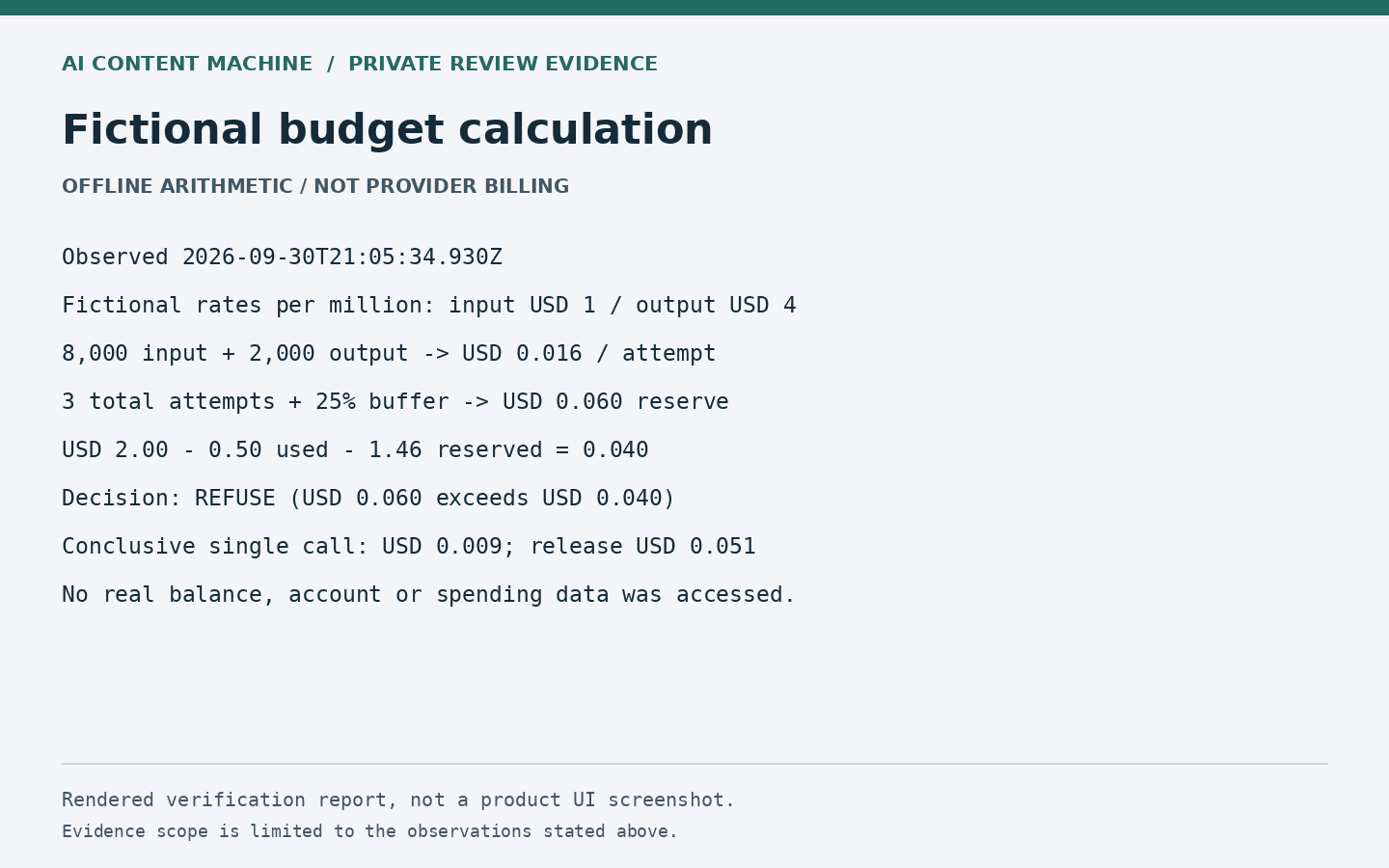
Fictional budget calculation; observed 30 September 2026. offline arithmetic / not provider billing. Rendered report, not a product UI screenshot. The original image retains its private-review label; the owner approved this historical report for publication on October 1, 2026.
Image provenance and reuse limits: publication asset manifest.