An article can load correctly in a browser while remaining absent from Google's index. It can also appear in an indexing report that describes an older version of the page. Publishing, technical accessibility, discovery and observed indexing are related stages with different evidence.
Use this checklist after an article has actually reached its production URL. For AI Content Machine, the production origin is https://theaicontentmachine.company. A preview deployment or local address can help review layout, but it cannot establish the state of the production article.
This article reports only public technical checks and a repeatable review method. No private Search Console or analytics data is reproduced. Indexing status remains unknown without relevant, authorized evidence from the correct property.
Confirm the exact production page
Start with the intended HTTPS URL, including its complete article path. Open it without an authenticated editing session and inspect the response status, redirects and visible content. Confirm that the final URL is the one you expect to share.
A 200 response means the server returned a successful HTTP response. It does not prove that the response contains the article. A generic error page, empty application shell or unrelated landing page can still require investigation, so read the heading and several body paragraphs.
Compare the visible article with the approved version. Check images, credits, internal links and the date information. A deployment can succeed while serving an older file or a route that was omitted from the build.
Keep a dated record for each URL rather than relying on a site-wide green check. The public evidence accompanying this article was collected on 30 September 2026; it is a snapshot, not a promise that every future deployment will retain the same metadata.
Inspect canonical and indexing directives
Read the canonical link in the rendered page or response HTML. It should represent the intended preferred URL. Compare host, scheme, path and trailing-slash behavior with the URL used in internal links and the sitemap.
A self-referencing canonical is a useful consistency check. It does not prove that Google selected that URL as canonical. The Google-selected canonical belongs to Google's indexed information and may differ from the site's declaration.
Check both robots meta tags and the HTTP X-Robots-Tag header for a noindex directive. Inspect robots.txt as well, but keep its purpose separate: crawl restrictions and indexing directives are different controls. Google's noindex guidance explains that Google must be able to access a page to see its noindex rule.
If a production article accidentally inherits preview restrictions, record the exact directive and where it appears before changing configuration. Do not broadly remove exclusions from an entire site without checking what private or non-public routes they protect.
Check discovery paths
Open the production sitemap and find the exact canonical URL. Confirm that it points to the intended host and a working page. A sitemap containing a preview URL or a redirecting variant deserves correction before it becomes a repeated discovery signal.
Google's sitemap guidance describes sitemaps as a way to communicate URLs and relevant metadata. Submission and inclusion do not guarantee crawling or indexing. Keep modification dates truthful rather than changing them automatically to suggest freshness that the article does not have.
Also follow an ordinary internal link from an index or related article. A URL listed only in a generated file can be technically discoverable while remaining difficult for readers to find. Verify the actual anchor target and the destination rather than assuming that a card title links correctly.
For this site, the article index, production sitemap and robots file are public inspection points. The check at 22:03 UTC on 30 September 2026 found 25 sitemap URLs, including five article URLs and ten individual workflow pages. All five articles returned 200 with matching declared canonicals; no robots meta or X-Robots-Tag directive was observed. The earlier 21-URL, six-workflow observation at 21:05 UTC remains the historical source for the unchanged report image below. Use each timestamped record only for the catalogue count observed at that time; neither observation proves Google indexing.
Read Search Console in the correct property
When you have authorized access, select the property that covers the production URL and enter that complete URL in the inspection tool. Avoid treating a preview host, alternate subdomain or different protocol as equivalent.
Google's URL Inspection documentation distinguishes indexed information from a live test. The indexed view reports what Google has recorded; the live test assesses the current page's accessibility and potential indexability. A passing live test does not prove that the URL has entered the index.
Record the observed status, inspection time, last crawl when available and the relevant canonical information. If the report reflects an earlier crawl, compare it with the deployment time before deciding that the latest fix failed. Reports and discovery do not necessarily update immediately after a release.
Without access, write “indexing status unknown.” Do not substitute HTTP 200, sitemap membership or an empty search result as a definitive diagnosis. A public technical audit should clearly stop at the evidence it can obtain.
Make the evidence useful and private
A compact per-URL record can contain the production URL, observation timestamp, response code, declared canonical, robots findings, sitemap membership, an internal discovery link and the next action. Add Search Console findings only in an authorized private record.
For a public tutorial, use your own captures of public pages or a public sitemap excerpt. Avoid screenshots of account menus, property ownership, private search queries, analytics metrics or identifiers. Cropping a dashboard does not automatically make its remaining data approved for publication.
Every image needs its source, creator, permission basis, caption, alt text, dimensions, byte count and file hash. The image should show the exact observation discussed in the article. A reconstructed interface or an invented success banner would misrepresent the evidence.
A rendered public HTTP verification report accompanies this article. No Search Console screenshot or private performance measurement is needed to explain the checklist.
Prioritize the next action
Resolve clear production defects first: a missing article, an unintended redirect, a wrong canonical, an accidental noindex directive or a broken discovery link. Recheck the affected URL after the approved fix is deployed and record what changed.
If the public checks are consistent but indexing remains unconfirmed, preserve that distinction. Review whether the article adds useful information, whether its references and examples are sound and whether it substantially duplicates existing pages. A clean technical checklist is only one part of making a useful search result.
Google's recrawl guidance says that requesting a crawl does not guarantee inclusion and that repeated requests do not accelerate crawling. Do not promise a deadline, automate repeated submissions or use the Indexing API for ordinary articles. No indexing request is part of this article's research.
Finish each review with a specific status such as “public checks passed; Google indexing unknown” and a reason for the next check. The released Delivery Reconciliation Reporter, WF13 v0.1.0, classifies supplied delivery evidence offline and always reports indexing unknown; it does not fetch Google data. Keep publication receipts, technical observations and search-engine reports separate so a successful step cannot silently stand in for the next one.
Verification evidence
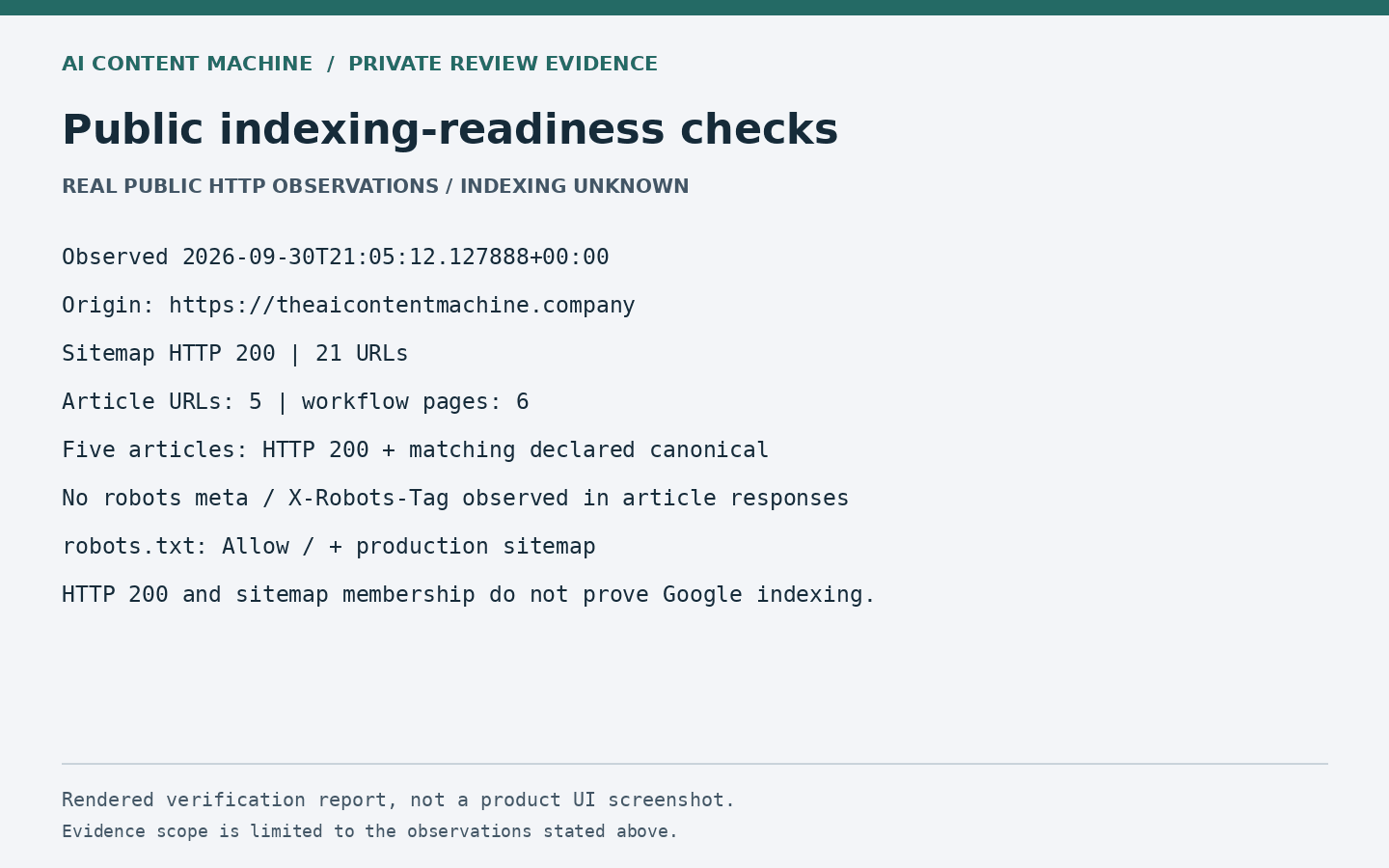
Public indexing-readiness checks; historical public HTTP observations at 21:05 UTC on 30 September 2026, before the catalogue expanded to ten modules. The image retains that earlier 21-URL snapshot. The 22:03 UTC refresh found 25 URLs; Google indexing remains unknown. Rendered report, not a product UI screenshot. The original image retains its private-review label; the owner approved this historical report for publication on October 1, 2026.
Image provenance and reuse limits: publication asset manifest.